Corporate clients
The houses we compose for





















Design · · By Carmen Raterman & Sandra Moreno
The 3:5:8 rule, explained with real numbers.
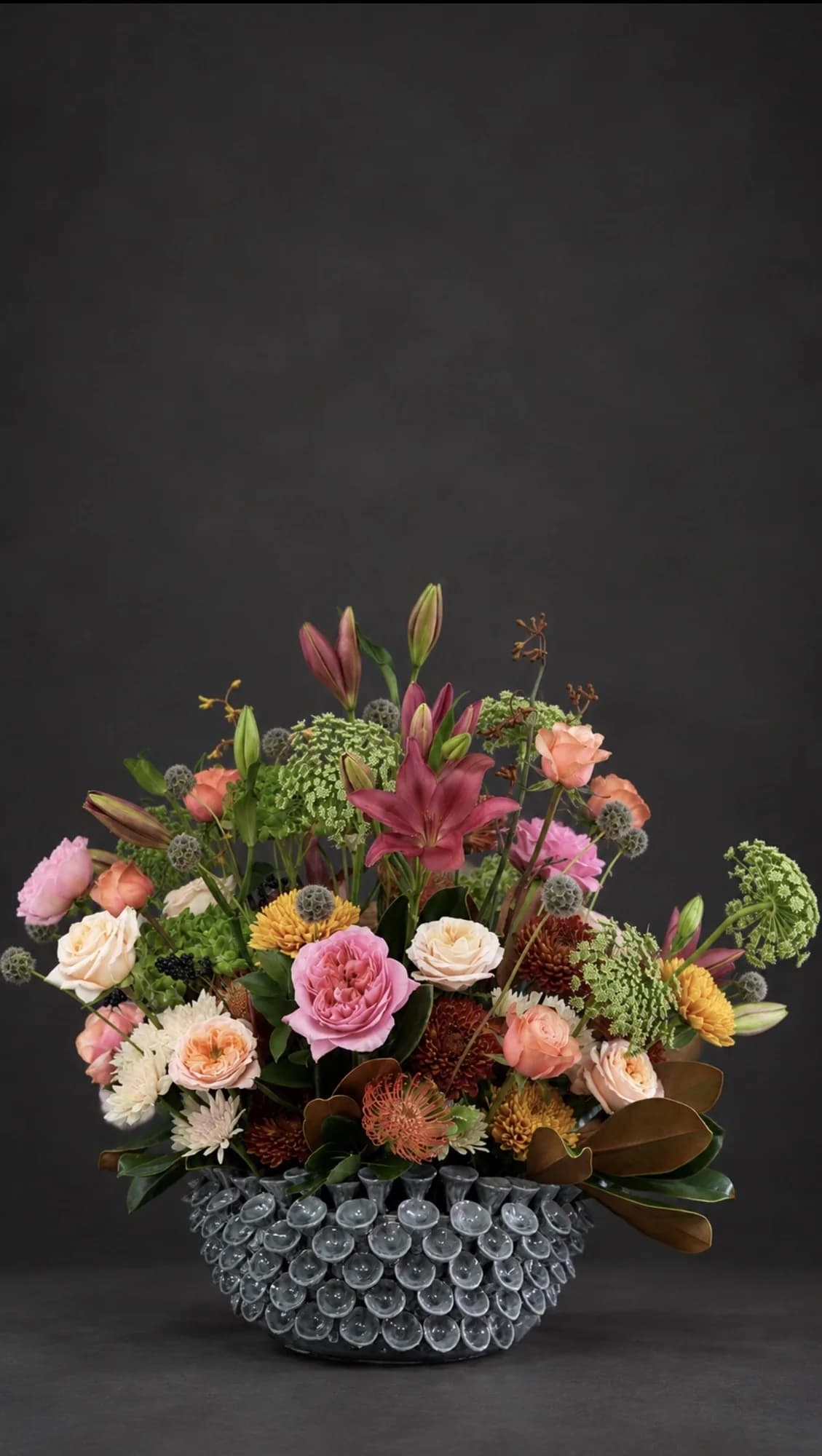
An arrangement can use beautiful flowers and still look wrong. The stems are too short for the vase, so the flowers sit in it like a lid. Or they shoot up so far the vase looks like it might tip. Usually the problem is proportion, and the 3:5:8 rule is one of the simplest ways to fix it.
The rule isn't a law. Good designers break it all the time. But it gives you a starting point, and once you understand it, you'll notice it in arrangements everywhere.
Where 3, 5 and 8 come from
The numbers come from the Fibonacci sequence: 1, 1, 2, 3, 5, 8, 13, 21, where each number is the sum of the two before it. As the sequence goes on, the ratio between neighboring numbers settles towards about 1.618, known as the golden ratio. 5 divided by 3 is about 1.67. 8 divided by 5 is 1.6.
The golden ratio has been linked with visual harmony for centuries, in architecture, painting and nature, from the spiral of a sunflower head to the arrangement of leaves on a stem. Whether it is truly special or simply a pleasing range is debated, but as a working rule for proportion it is useful.
The vessel and the flowers
The most common use is height. Think of the arrangement in three parts:
In plain terms, the flowers above the vase should be roughly one and a half to two times the height of the vase.
Worked examples:
For low, wide bowls, apply the rule to width instead of height. The flowers spread about one and a half to two times the width of the bowl.
- The vessel is 3 units.
- The flowers rise 5 units above the rim.
- The total height is 8 units.
- A 6-inch vase: flowers rise about 10 inches above the rim, for an overall height of about 16 inches.
- A 9-inch vase: flowers rise about 15 inches, for an overall height of about 24 inches.
- A 12-inch urn: flowers rise about 20 inches, for an overall height of about 32 inches. This is a statement piece for a lobby or a console.
Stems in 3s, 5s and 8s
The rule also guides stem counts. Odd groupings look natural because the eye can't split them into matching halves. A cluster of three roses looks gathered. Two looks like a pair, and four tends to look like a square.
So designers group focal flowers in threes and fives, and larger groups in eights, then step the groups through the arrangement. This creates rhythm, rather than an even scattering of each flower.
How the shape changes the rule
The vessel shape changes how the rule is applied.
- Tall cylinders: the classic case. Apply 3:5:8 to height, and let a few stems fall over the rim to soften the line.
- Compotes and footed bowls: these raise the flowers off the table. Designers often treat the foot and bowl together as the 3, and let the flowers spread wider than they rise, with trailing stems over the edge.
- Urns: heavy and wide, so they can carry tall, generous arrangements. They're the natural vessel for statement pieces.
- Low bowls and troughs: apply the rule to length and width. A trough on a long table may be much longer than it is tall.
- Bud vases: break the rule freely. One stem, well placed, is enough.
What usually goes wrong
A few common problems, and how to fix them:
- Stems cut too short: the flowers sit on the rim. Cut the tallest stem first and measure against the vase.
- Every stem the same length: the arrangement looks like a dome. Step heights down from the tallest stem.
- Too many focal flowers: nothing leads. Choose one main flower and let the rest support it.
- Even spacing: each flower sits alone. Group in odd numbers.
- Wrong vase for the space: a tall arrangement on a dining table blocks the view. A tiny vase in a big lobby disappears. Choose the vessel for the setting first.
Dominant, secondary and accent
The third use is visual weight. An arrangement reads better when one element clearly leads.
Interior designers use a similar idea, the 60-30-10 color rule, and it works the same way in flowers. Without a clear lead, an arrangement can look busy, with each flower competing.
- Dominant (8): the main flower or color. For example, garden roses.
- Secondary (5): a supporting flower or color. For example, ranunculus.
- Accent (3): a small amount of contrast. For example, a few stems of a darker flower, or a texture like seeded eucalyptus.
When designers break the rule
The rule is a guideline, and many good designs ignore it.
- Dinner centerpieces: guests need to see each other across the table, so low centerpieces usually stay below about 12 to 14 inches. Height comes from candles instead. The rule then applies to width and balance.
- Tall centerpieces: for ballrooms and high ceilings, arrangements go on tall stands so the flowers sit above seated eye level. The proportion between stand and flowers still matters.
- Installations: arches, hanging pieces and large-scale work follow the space, not the vessel.
- Ikebana and minimal styles: Japanese ikebana uses its own system of proportions, and minimal designs often use a single stem much taller than the vessel on purpose.
- Bud vases: one or two stems in a small vase can rise well above the 3:5:8 proportions and still look right.
Using the rule with market flowers
You can use the rule with a supermarket bunch and a vase from the cupboard.
1. Measure the vase. Say it's 7 inches tall. 2. Work out the target. Flowers should rise about 10 to 14 inches above the rim. 3. Cut the tallest stem first. Hold it against the vase so it rises about 12 inches above the rim, add the depth of the vase, and cut at an angle. 4. Cut the rest progressively shorter. Step stems down so the arrangement has a high point and a fuller middle. 5. Group the focal flowers in odd numbers. Place three or five together rather than spacing them out. 6. Add greenery last, to fill gaps and soften the rim. 7. Step back. Look from across the room. If the flowers look like they're sitting on the vase, they're too short. If the vase looks small, they're too tall.
Use a clear vase only if the stems look tidy, or line it with a leaf.
Proportion across the range
You can see proportion at different scales in the studio's designs. The Bay Way is a compact vase arrangement for a side table or a desk. The Habana Way at $1,000 is a statement piece where height and spread are part of the design. Our wedding work shows low and tall centerpieces side by side, and the gallery has many more examples.
Why proportion shows on camera
A phone camera flattens depth, so an arrangement that looks balanced in the room can look squat in a photo. Arrangements built with height about one and a half to two times the vessel tend to photograph well from a standing height.
FAQ
3:5:8 rule questions.
What is the 3:5:8 rule in floral design?
A proportion guideline based on the Fibonacci sequence. If the vase is 3 units tall, the flowers rise about 5 units above it, for an overall height of 8.
How tall should flowers be compared with the vase?
About one and a half to two times the height of the vase, measured above the rim. For a 6-inch vase, that's about 9 to 12 inches.
Does the 3:5:8 rule apply to wedding centerpieces?
Not for height. Low centerpieces stay below about 12 to 14 inches so guests can see each other. The rule is used for width and balance instead.
Why do florists use odd numbers of flowers?
Odd groupings look more natural, because the eye can't split them into matching halves.
Is the 3:5:8 rule the same as the golden ratio?
They're related. Ratios between consecutive Fibonacci numbers, such as 5:3 and 8:5, approach the golden ratio of about 1.618.